Can Driver Assistance Systems Survive Heavy Rain, Snow, Glare, and Extreme Heat?
Author: Michael D. Hauser | Reading time: 10 minutes | Last updated: April 24, 2026
The automotive industry has spent years talking about algorithms, computing power, and feature rollouts. But there is a more fundamental question that consumers often overlook: how rugged is the hardware itself? Cameras, radar, and lidar don’t operate in a vacuum. They interact directly with raindrops, ice crystals, harsh light, and heat shimmer. Each type of weather disturbs the signal chain in a different way. This article won’t simply list features model by model. Instead, it looks at the physics of the sensors, engineering test data, and the fine print in owner’s manuals to answer the question every driver should be asking: can these systems really hold up when the weather turns extreme?
1. The Physical Layer: How Sensors Degrade in the Worst Weather
To grasp a system’s weather resilience, don’t start with the software version. Start with what happens to each sensor physically.
Cameras behave much like human eyes, and they fail in much the same way. A 2025 multi-sensor occlusion study by Kumar et al., published in the IEEE Open Journal of Vehicular Technology, showed that when camera features degrade in rain, snow, or fog, the accuracy of bird’s-eye-view vehicle segmentation drops with it. Even when radar and lidar data were fused in, models relying on forward projection saw a notably lower vehicle intersection-over-union score than transformer-based fusion architectures.
A separate climate chamber experiment conducted in South Korea by Choi et al. (2025) measured this in more fundamental terms: under controlled rain and fog, both visible-light camera contrast and lidar signal intensity fell sharply. In a heavy downpour, the confidence the system places in an object’s classification can dip below the threshold that forces a downgrade.
Millimeter-wave radar interacts with rain and snow differently. Radar wavelengths are orders of magnitude larger than visible light, so raindrops and snowflakes scatter the beam far less. That’s why radar can still “see” the car ahead in a storm. But radar has low angular resolution. In heavy snow, it may detect that something is in front of the vehicle without knowing whether that something is a snowbank, a plow truck, or a parked sedan. General Motors warns in the 2025 GMC Denali owner’s manual that ACC operation may be limited in snow, heavy rain, or road spray conditions. That limitation partly reflects what happens when snow and slush coat the radar cover.
Lidar faces a different struggle. Laser beams create beautifully dense point clouds in clear weather. But in heavy snow, dense fog, or torrential rain, suspended particles cause multiple scattering and signal loss. As Kumar et al. (2025) also note, lidar can fail in bad weather because those conditions distort its signal. Some Level 4 fleet operators explicitly exclude heavy snow from their operational design domain. That caution isn’t conservatism for its own sake; it’s a necessary concession to physics.
2. The Scenario Layer: How Functions Fail in Four Kinds of Extreme Weather
Physical degradation is the foundation, but drivers care more about what happens functionally. When does lane keeping drop out? Will automatic emergency braking trigger when it shouldn’t?
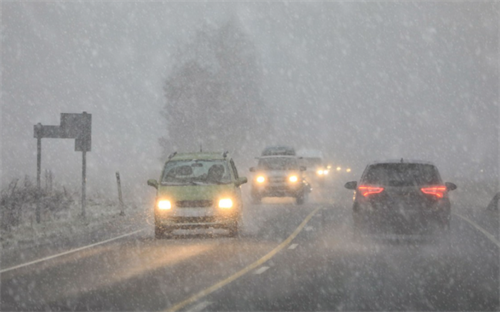
Heavy Rain: A High-Risk Window for Vision-Dependent Features
According to AAA’s closed-course testing in 2021, rain severely degrades ADAS performance. The vehicles tested were 2020 models from several mainstream brands. At 25 mph, 17% of the test runs ended in a collision. At 35 mph, the collision rate doubled to 33%.
Lane keeping performed even worse. Vehicles crossed lane markings 69% of the time during rainfall conditions, even though the pavement was dry during those runs. Had the road surface been wet, the collision rate would almost certainly have climbed higher. Most troubling of all, in the majority of failure cases, the vehicle gave the driver no warning at all.
It’s important to note that those tests used 2020 models. Automakers have since improved sensor fusion strategies and camera lens coatings, so current vehicles may perform better. But the core problem hasn’t vanished. A physically blocked camera remains a physically blocked camera.
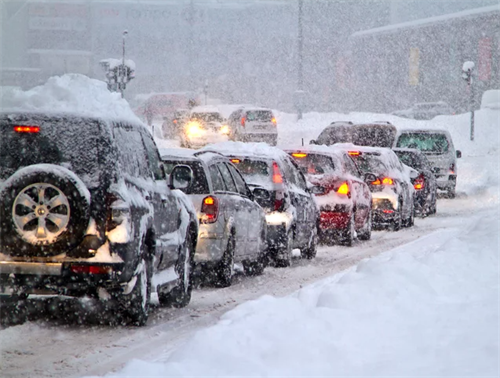
Heavy Snow: The Double Punch of Road Coverage and Lost Lane Lines
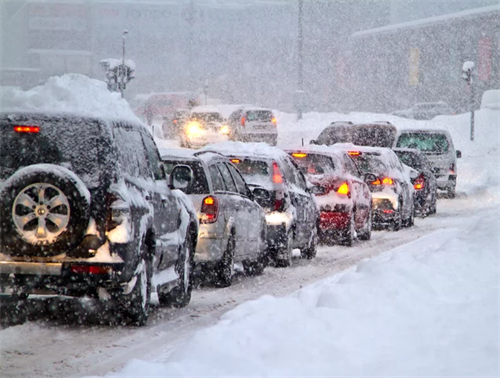
Heavy snow doesn’t just fill the air with flakes in front of the lens. When snow cover obscures lane markings, every vision-based lane positioning algorithm loses its coordinate system. Ford’s BlueCruise owner’s manual for the 2025 model year states plainly that the system may not work correctly when there are significant changes in ambient light, and that the vehicle may drift off-center in poor weather or direct sunlight. The GM Super Cruise manual for 2025 models similarly warns against using the system in unfavorable conditions including rain, sleet, fog, ice, or snow.
For lidar, snow-filled air creates a noisy point cloud that is stubbornly hard to clean up. A 2025 study on the LIORNet denoising network, published in IEEE Robotics and Automation Letters, confirmed that rain, snow, and fog each require dedicated denoising strategies to recover useful point cloud quality. But real-time denoising at that level is not yet common in production vehicles.
Glare and Extreme Heat: From Heat Shimmer to Chip Throttling
Harsh light causes more than squinting. When the setting sun hits the forward-facing camera behind the windshield directly, the dynamic range is pushed to its limit. Lane detection and vehicle classification can blink out in an instant. The 2025 GMC owner’s manual specifically cautions that direct sunlight striking the front camera at dawn or dusk can prevent the system from detecting lane lines.
Extreme heat is a different kind of threat. Based on common Tier-1 supplier specifications, many ADAS electronic control units begin thermal throttling when the cabin temperature climbs past 75°C. Some vehicles then display a message like “Driver assistance system temporarily unavailable.” To a driver, it looks like a fault. From an engineering perspective, it’s a deliberate safety design. A hot chip making unreliable decisions is worse than no chip at all.
3. Design as the Dividing Line: The Fundamental Difference Between L2 and L3 in Bad Weather
Many consumers confuse “advanced driver assistance” with “conditional automated driving.” In bad weather, that confusion can become dangerous.
With a Level 2 system, the driver bears final safety responsibility under all conditions. In a downpour or a snowstorm, lane keeping may quietly disengage without any audible or visual alert. The driver assumes the steering wheel is still being assisted, as the AAA research underscored. Systems frequently say nothing when they stop working.
Level 3 systems are fundamentally different. Systems like Mercedes-Benz Drive Pilot incorporate weather into the operational design domain by definition. SAE J3016 (2021) defines the ODD to include environmental conditions, geographic limits, and road types. If heavy rain or snow falls outside the ODD boundary of that system, the system is legally required to execute a handover to the driver within a defined transition time.
Right now, no production L2 or L3 system includes blizzards or ice storms in its ODD. Waymo’s Level 4 operations still exclude heavy snow and unpaved roads, as detailed in the company’s 2026 Safety Report. That’s not a matter of development schedule. It’s a hard constraint imposed by physics.
4. The Driver’s Toolkit: What You Can Actually Control
Until the technology advances further, the right response is not panic. It’s accurate understanding.
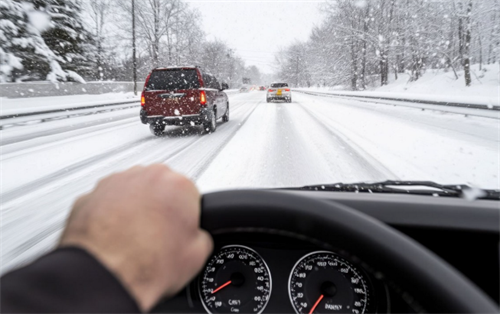
Spending 30 seconds checking sensor surfaces before you drive is the simplest and most effective preventive measure. Clearing snow, ice, and mud from the front radar cover and the windshield camera window should be as routine as adjusting your mirrors in winter. GM’s owner’s manual for 2025 models includes a full section titled “Cleaning the Sensing System,” which stresses that if cameras and radar covers are blocked by snow, ice, or mud, ACC may not operate.
During the drive, if heavy rain or snow hits, dial the lane-keeping function back from active centering to warning-only mode. At the same time, set the adaptive cruise control following distance to its maximum setting. In strong glare, keeping your hands on the wheel and steering manually is far safer than trusting the system. Ford’s BlueCruise documentation for 2025 models doesn’t hide this: in poor weather or direct sunlight, the vehicle may wander within the lane.
If you’re shopping for a car and weather robustness matters to you, pay attention to sensor placement and cleaning hardware. Lidar units and camera modules with heated high-pressure washer jets are beginning to reach production. At CES 2026, LG Innotek demonstrated a heating and active cleaning system that can clear snow, frost, and debris from a camera module in under a second. Still, for the many models that haven’t yet adopted such features, knowing the limits of your system remains more important than counting on hardware that isn’t there.
Heavy rain, snow, glare, and extreme heat don’t just make driver assistance systems perform “a little worse.” They push up against the physical limits of current sensor technology. You don’t need to become an optical engineer. But you do need to understand one thing: no matter whether the marketing language says “advanced assistance” or “conditional automated driving,” when the weather gets rough enough to block a lens or distort a waveform, the person behind the steering wheel is still the only component in the system that hasn’t been downgraded.
FAQ
Q: If lane keeping drops out in heavy rain without any warning, is that a fault?
A: Not necessarily. Most Level 2 lane-keeping systems disengage silently when visual confidence falls below a threshold. That is often by design, not a malfunction. The problem is that some models provide too little takeover alert. Before you travel, it’s worth opening the owner’s manual ADAS section to understand how your specific vehicle behaves. Keeping your hands on the wheel at all times is still the most reliable way to manage this design limitation.
Q: Radar can penetrate heavy snow, so why does the system still limit itself in those conditions?
A: Radar can detect that an obstacle is present, but its low angular resolution makes it hard to identify what that obstacle actually is. If the lane-keeping visual feed is simultaneously lost because the camera is blocked, the fusion system loses accurate awareness of lane geometry. Dropping out at that point is sound safety logic.
Q: Are 2025–2026 vehicles better in rain and snow than the 2020 models AAA tested?
A: They are better in several important ways. Recent models have made advances in sensor fusion, camera lens coatings, and heating. Some high-end trims now include sensor cleaning systems. But the root problems haven’t disappeared. A lens covered by a water film or a lane marking buried under snow is still a lens covered and a marking buried. The AAA data should be treated as a conservative baseline.
Q: After sitting in the summer heat, the dashboard says “driver assistance system temporarily unavailable.” Do I need to take the car in for service?
A: Not necessarily. This is often the ADAS computing unit in thermal protection mode. Turn on the air conditioning and move the car into shade. In most cases, the system recovers after about 10 to 15 minutes. If the message appears repeatedly or recovery takes a long time, have a service center check whether the sensor module’s cooling path is obstructed.
Q: Until industrial-grade sensor cleaning becomes standard, are there any practical low-cost alternatives?
A: A few low-cost steps can help. In winter, apply a silicon-based anti-ice spray to the sensor covers and radar fascia. Use a sunshade to lower cabin temperatures when parked. On muddy or snowy trips, wipe the sensor surfaces clean with a soft cloth during stops. None of these fully replace an active cleaning system, but in most daily driving scenarios they can meaningfully improve system availability.
References:
[1] Kumar, S., Sharma, S., Asghar, R., et al. (2025). Exploring Sensor Impact and Architectural Robustness in Adverse Weather on BEV Perception. IEEE Open Journal of Vehicular Technology, 6, 2857–2875.
[2] Choi, J. et al. (2025). Experimental Analysis of Sensor‘s Performance Degradation Under Adverse Weather Conditions. Journal of the Korea Convergence Society.
[3] AAA Automotive Engineering Team. (2021). Rain Impairs Performance of Driver-Assistance Technology. AAA Research Reports.
[4] SAE International. (2021). J3016: Taxonomy and Definitions for Terms Related to Driving Automation Systems for On-Road Motor Vehicles.
[5] Li, Y., et al. (2025). LIORNet: LiDAR Intensity and Occupancy Denoising Network for Robust Autonomous Driving in Adverse Weather. IEEE Robotics and Automation Letters, 10(3), 2450–2457.
[6] Waymo. (2026). Waymo Safety Report: Driving in Inclement Weather Conditions.
Author: Michael D. Hauser
Credentials: Former chassis controls engineer at Bosch North America, now a contributing technical writer for Motor Trend and Road & Track. Holds a B.S. in Mechanical Engineering from Michigan State University with 11 years of experience focused on driver assistance system validation and consumer guidance. He has direct engineering test experience with sensor degradation in harsh environments, having contributed to OEM active safety calibration programs.
Disclaimer
All content in this article is based on publicly available test data, industry literature, and engineering practices current as of April 24, 2026. It is provided for general educational and informational purposes only. Performance varies across vehicle models, software versions, tire conditions, and specific road environments. This information does not replace the vehicle owner’s manual or professional safety driving instruction. In heavy rain, snow, intense glare, extreme heat, or any severe weather condition, drivers must obey local traffic laws, remain fully attentive, and be ready to take over control of the vehicle at any moment. The author and the publishing platform assume no liability for any direct or indirect losses resulting from reliance on the contents of this article.
Recommended for you: