L3 Autonomous Driving Accidents: Who Is Actually Liable?
Author: Robert Shaw | Last Updated: April 23, 2026|Reading Time: Approx. 8 minutes
One of the most talked-about topics in the automotive world lately is the arrival of the first production vehicles equipped with Level 3 conditional automated driving.
From the Voyah Dream to the Audi E7X, several models have received official approval for mass production in China and Europe (source: China MIIT L3 production approval list, December 2025; Audi AG press release, March 2026).
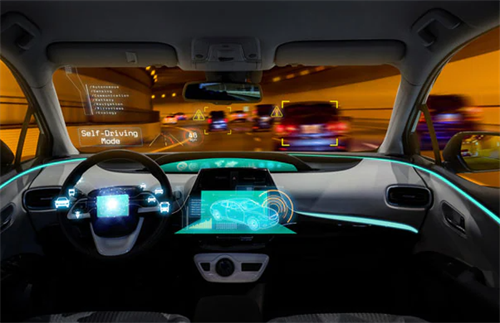
This means a significant number of drivers will soon encounter a completely new scenario during their daily commute: press and hold the smart driving button on the steering wheel, and the car begins to handle following distance and lane changes on its own. Meanwhile, you—the person sitting behind the wheel—can look away from the road to check the central display or catch up on work messages.
This small step in reducing driver workload actually represents a major shift in automotive legal relationships.
With Level 2 driver assistance, no matter how much longitudinal or lateral control the system helped with, the final authority over the steering wheel and brakes always rested with the human driver.
At Level 3, the rules change. The system takes full control of the dynamic driving task under specific operating conditions. It is responsible for watching the road, making decisions, and executing them. You do not need to monitor it, but you must be ready to resume the role of driver the moment the system encounters a situation it cannot handle.
The logic of switching between who is in charge, who is watching the road, and who takes over brings the issue of liability into sharp focus. When two different driving agents—human and machine—take turns operating a vehicle, and an accident occurs, should we trace the cause back to the system's decision or the driver's response?
This is not a black-and-white technical question. It is a complex issue involving law, insurance, and user understanding. Let's start from there and break down the most practical concerns for car owners in the Level 3 era.
1. Level 3 Is Here, and Your Steering Wheel Isn't 100% Yours Anymore
To discuss liability, we first need to understand the fundamental difference between Level 3 and the Level 2 features that have dominated the market in recent years. We can explain the division of labor between these levels in the simplest terms.
Level 2 driver assistance—no matter how fancy the marketing terms are, like Navigate on Autopilot or Highway Assist—has a clear legal definition: the vehicle is driven by a human, with the system providing support. Even with adaptive cruise control and lane centering activated and your hands momentarily off the wheel, traffic laws still consider you the sole operator. If the system exceeds its capabilities, it neither bears nor is capable of bearing any legal responsibility. In short, you are driving the car. If something happens, the police will look only at the person behind the wheel.
Level 3 is the first time a portion of the legal driving task is delegated to the machine.
Within its Operational Design Domain (ODD)—for instance, on specific highway sections, during daylight, in clear weather, and at speeds below 80 km/h—the system is obligated to handle environmental perception, path planning, and dynamic control. The driver is not required to monitor the system's performance (source: SAE International, J3016_202104, Level 3 definition).
But this handoff mechanism contains a critical design element: when the system cannot cope, it hands control back to you, and you must be ready to take it. Once it issues a visual and audible takeover request, the responsibility shifts from the system to the driver.
This "I'm responsible when I drive, you're responsible once I hand it over" model is exactly why Level 3 liability can be so contentious.
Because of this, the clarity of liability varies significantly across different levels of automation. Here is a quick overview comparing the most common SAE levels to help you quickly grasp the big picture:
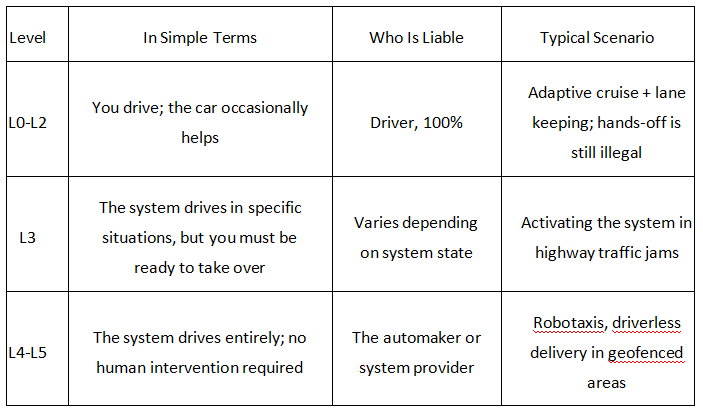
The core message of this table is clear: from Level 0 to Level 2, the driver's responsibility is absolute and cannot be transferred. The Supreme People's Court of China also clarified in its 2025 guidelines for autonomous driving accident cases that driver assistance systems only play a supporting role; the driver retains the primary duty to ensure safe driving (source: Supreme People's Court of China, "Guiding Opinions on the Trial of Civil Cases Involving Autonomous Driving Vehicles," issued March 2025).
Level 3 marks the first time that legislation explicitly states: when the system is active and functioning correctly, the vehicle manufacturer or system provider assumes direct liability for accidents. The most cited example is Germany's Eighth Amendment to the Road Traffic Act (StVG), which came into force in 2021 (source: German Straßenverkehrsgesetz, Eighth Amendment, July 2021). Levels 4 and 5 extend this liability framework to an even wider range of operating scenarios.
For the average car owner, this chart reflects a real change. If you drive a Level 2 car, there is almost no room for debate about who is liable after a crash—the person behind the wheel always bears primary responsibility. But if you are driving a Level 3 vehicle, the system's state at the time of the crash, the takeover timestamp, and the Data Storage System for Automated Driving (DSSAD) records will all become key pieces of evidence in determining who is at fault.
2. Breaking Down the Scenarios: Four Different Outcomes for the Same Level 3 Car
Since liability for Level 3 depends on what the system was doing and whether you did what you were supposed to, we cannot give a single blanket answer. We need to examine the real-world circumstances of an accident. Let's explore four typical scenarios to clarify the legal and practical logic behind each one.
Scenario 1: System Active, No Takeover Request — The Automaker Is Liable
Imagine this: you are driving a Level 3 vehicle on the highway. The automated driving system is active, and the weather, road conditions, and speed are all within the system's defined operating limits. The car maintains a steady following distance, and the system continuously monitors the environment.
Suddenly, the car ahead brakes hard, but your vehicle's perception sensors or decision-making algorithm fail to respond. The car does not slow down at all and rear-ends the other vehicle.
In this case, the path to determining liability is relatively straightforward. Since the system was active and had not issued a takeover request when the accident occurred, the direct cause is a failure in the system's functionality.
Under the principles established by Germany's Eighth Amendment to the Road Traffic Act (StVG, 2021), the liability shifts from the driver to the vehicle manufacturer or system supplier. While the legislative framework in China is still evolving, the initial design of Beijing's pilot program for smart connected vehicle insurance follows similar logic: if the accident is caused by the autonomous driving system, the automaker's insurance policy will cover the damages (source: Beijing Municipal Financial Regulatory Bureau, "Pilot Implementation Plan for Smart Connected Vehicle Insurance," January 2026).
Scenario 2: System Requests Takeover, Driver Fails to Respond — The Driver Is Liable
Again, consider a highway scenario. This time, however, the Level 3 system detects a complex construction zone ahead (or an unclear lane marking requiring emergency avoidance). It issues a "Please Take Over" alert with audible cues, dashboard text, and possibly steering wheel vibration. The system provides a roughly 10-second response window, as required by UN R157 regulations (source: UNECE Regulation No. 157, paragraph 5.2.3, 2021).
You are looking at your phone at that moment and miss the alert. By the time you look up, you have missed the safe takeover window, and a collision occurs.
For these situations, the wording in the German Road Traffic Act is quite direct. Once the system issues a takeover request, the duty to respond and regain control falls entirely on the driver. If you fail to adjust your posture, grip the steering wheel, and confirm takeover in time, the consequences are on you. Simply put, whether or not you "catch" the steering wheel determines where the legal liability lands.
Scenario 3: Data Records Are Unclear — Entering the "Gray Zone" of Liability
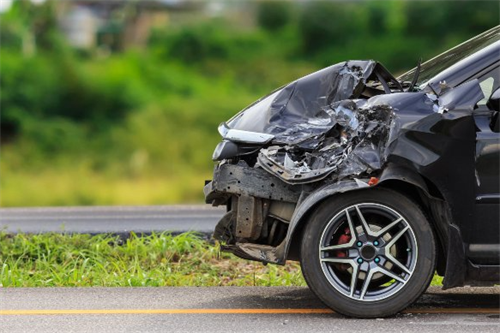
This is one of the most challenging scenarios in legal practice. What happens if the vehicle's Data Storage System for Automated Driving (DSSAD) malfunctions, is tampered with, or suffers signal interference, leaving key data missing for the period around the crash? In such cases, we cannot reconstruct the system's state or the driver's actions.
Professor Shen Jianfeng of the Central University of Finance and Economics School of Law has pointed out that under the Level 3 alternating-control framework, determining whether a crash was caused by system failure or human error often requires highly precise technical forensic analysis. If the DSSAD data is insufficient to support a definitive expert opinion, the rights of victims can be significantly delayed (source: Shen Jianfeng, "Legal Challenges of Autonomous Driving Accident Liability," China Legal Science Journal, Vol. 43, Issue 2, 2025).
During discussions surrounding Beijing's insurance pilot program, stakeholders have repeatedly emphasized the need for a "pay now, settle later" mechanism to handle cases where the data is disputed, thereby reducing the time victims spend waiting for compensation (source: Beijing Municipal Financial Regulatory Bureau, pilot program Q&A document, February 2026).
Scenario 4: Driver Evades System Monitoring — The Driver Bears Full Responsibility
This final scenario involves an intentional violation. A widely reported case from the Traffic Management Bureau of the Ministry of Public Security described an incident where a driver activated Level 2 driver assistance on the highway but used a steering wheel weight to trick the driver monitoring system. With his hands completely off the wheel, the system triggered its safety protocol and brought the car to a stop, leading to a rear-end collision with a truck. The police found the driver fully at fault for the accident (source: Traffic Management Bureau of the Ministry of Public Security, "Typical Cases of Traffic Accidents Involving Driver Assistance Systems," published April 2025).
Extending this logic to Level 3 is straightforward: any deliberate act to circumvent the driver monitoring system—whether using a weight, a "hands-off" gadget, or any other defeat device—will almost certainly result in the most unfavorable legal outcome for the driver if an accident occurs.
The moment the DSSAD records an anomaly in the Driver Monitoring System (DMS) signal, the driver's legal standing deteriorates rapidly. Trying to cheat the system to make driving easier can lead to consequences far worse than just staying attentive.
3. After an Accident, How Do You Prove Whose Fault It Was?
As the previous examples show, data is the crucial variable in determining liability for Level 3 accidents. Whoever holds the more complete and credible evidence will have a stronger position in negotiations or court.
UN Regulation No. 157 mandates that Level 3 and above vehicles must be equipped with a DSSAD. This system continuously records a wide range of data points—including driving mode status, vehicle speed, accelerator and brake pedal positions, steering angle, and whether the driver was holding the wheel or looking at the road—typically for 30 seconds before an event to 5 seconds after. The recorded data is designed to be tamper-proof and is stored in a standardized format for independent access and analysis (source: UNECE R157, Annex 4, DSSAD technical requirements, 2021).
In this new data-driven reality for accident investigation, here are three practical suggestions for Level 3 vehicle owners:
First, fully understand the DSSAD data recording mechanism and avoid any product that claims to bypass it. Products like "steering wheel weights" or "hand-over detectors" are still sold unofficially online. If the DSSAD records an interruption in the DMS signal, you are effectively adding a very unfavorable piece of evidence to your own accident file.
Second, build a basic awareness of your insurance coverage. In early 2026, Beijing launched a pilot program for commercial insurance products tailored to intelligent connected new energy vehicles. The basic idea is to provide an additional layer of coverage for specific risks caused by autonomous driving systems, on top of the mandatory traffic accident liability insurance and standard commercial third-party liability coverage (source: Beijing Pilot Plan, January 2026).
If you frequently use Level 3 features, it is worth taking some time to compare the coverage between these new "smart driving" policies and your standard car insurance—especially for scenarios like single-vehicle accidents that occur while the automated driving system is engaged. When the system makes a mistake, the ease of your claims process depends heavily on whether your insurance policy's fine print explicitly covers situations where the machine is at fault.
Third, immediately exercise your right to access the data after an accident. If you are confident that you fulfilled your duty of care—timely response to takeover requests, hands on the wheel, eyes on the road—then, in addition to notifying the police and your insurer, you should formally request that the vehicle manufacturer provide a copy of the DSSAD data from the time of the crash.
Under current industry practices, vehicle owners generally have the right to view this driving data (source: UNECE R157, Annex 4, data access provisions). It is the single most important piece of evidence you will have to support your version of events in any legal proceeding.
Many in the industry consider 2026 to be the starting line for the widespread adoption of Level 3 automated driving. Several automakers have announced their Level 3 production plans. But everyone involved knows that technical readiness does not automatically mean the entire ecosystem is ready.
The specific rules for determining liability, the actuarial models and scope of insurance products, and the public's accurate understanding of "human-machine co-piloting"—all of these areas are still in a state of rapid development and uncertainty.
The framework of the UK's Automated Vehicles Act 2024 is built around a simple principle: in the event of an accident while the vehicle is in autonomous mode, the insurer pays the victim first and then has the right to seek reimbursement from the manufacturer if the system was at fault (source: UK Automated Vehicles Act 2024, Part 1, Section 2). This model significantly shortens the time it takes for an injured party to receive compensation.
Germany has gone a step further, explicitly writing the rules for liability during Level 3 system activation into its Road Traffic Act (StVG, 2021). China's progress is also happening quickly, and the insurance pilot program in Beijing has laid some of the groundwork for a localized "pay now, settle later" system.
For the average Level 3 car owner, perhaps the most sensible mindset is to maintain a clear awareness of where the boundaries lie. Level 3 gives you more freedom than Level 2. You can briefly look away from the road, briefly take your hands off the wheel, and do things other than driving. But it has never offered a complete liability waiver.
Systems can fail. Road conditions can change unexpectedly. The crucial handoff of control at a critical moment still requires you to be a functional human driver, ready to take over.
That's why understanding the legal role you play inside your own car and knowing the true limits of the Level 3 system are far more important than obsessing over numbers in a marketing brochure. Because the real test in this technological shift lies in the seamless and safe transfer of that steering wheel.
FAQ
Q1: I just bought a Level 3 car. If an accident happens, am I completely off the hook?
A: Not entirely. Level 3 liability shifts to the manufacturer only under specific conditions: the system was active, it had not issued a takeover request, and you were not intentionally evading driver monitoring. You can still be held responsible if you miss a takeover alert, have your hands off the wheel improperly, or use devices to cheat the system.
Q2: Do I absolutely need to buy special "smart driving" insurance for a Level 3 car? Isn't standard car insurance enough?
A: Beijing has launched a commercial insurance pilot for smart cars, but it is not mandatory. You can choose between a tailored policy and a standard one. However, coverage under a standard policy for accidents that occur while the automated driving system is engaged can be quite limited. It is best to assess this based on how often you actually plan to use Level 3 features and your own personal risk tolerance.
Q3: If I rent a Level 3 car while traveling abroad, are the liability rules the same everywhere?
A: No, they are not. Germany, the UK, Japan, and several U.S. states each have their own distinct legal frameworks for Level 3 liability. While the broad logic is converging, the specifics—such as required takeover time, data recording standards, and insurance claim procedures—can vary. Before renting, it is a good idea to ask the rental company about the local procedures for handling accidents involving automated driving features.
Q4: Once the Level 3 system is active, can I completely ignore the steering wheel?
A: It depends on the specific vehicle's certification and type approval. Even when Level 3 regulations allow you to look away from the road briefly, the current framework still typically requires you to maintain a physical posture and a level of awareness that would allow you to take over "immediately" or "promptly." You should carefully read the section in your owner's manual on takeover obligations. Different manufacturers have interpreted these requirements in subtly different ways.
Q5: If I suspect a system malfunction caused the accident, what steps should I take to file a claim?
A: Step 1: Preserve evidence at the scene and immediately request that the vehicle manufacturer secure a copy of the relevant DSSAD data.
Step 2: Work with the traffic police to complete an accident report that accurately notes the operational state of the driving system at the time of the crash.
Step 3: Follow your insurance policy's procedure to file a claim. Depending on the preliminary data, the insurer may handle it initially, or the manufacturer's claims department may get involved directly. If there is a dispute involving multiple parties, it is wise to consult a lawyer or a technical forensics expert with experience in automated driving systems.
References
[1] UNECE Regulation No. 157, Uniform provisions concerning the approval of vehicles with regard to Automated Lane-Keeping Systems (ALKS). United Nations Economic Commission for Europe, 2021. Establishes core technical certification standards for Level 3 systems, including mandatory DSSAD data recording.
[2] SAE International, J3016_202104: Taxonomy and Definitions for Terms Related to Driving Automation Systems for On-Road Motor Vehicles. The internationally recognized standard for defining Levels 0 through 5 of driving automation.
[3] German Road Traffic Act (Straßenverkehrsgesetz, StVG), Eighth Amendment, 2021. The world's first specific legislation establishing that the vehicle manufacturer bears liability for an accident occurring while an L3/L4 system is properly engaged.
[4] UK Automated Vehicles Act, 2024. Establishes a safety authorization scheme and sets out the rules for insurers to compensate victims first and then seek recovery from the manufacturer.
[5] California Vehicle Code, Division 16.6, Autonomous Vehicles (Section 38750), 2025 edition. The core regulatory framework for autonomous vehicle testing and deployment in California, with detailed provisions on insurance requirements and liability allocation.
About the Author:
Robert Shaw, Member of SAE International, with over 15 years of experience in automotive safety systems and regulatory compliance. He spent a decade as a senior systems engineer at a Detroit-based Tier 1 supplier, specializing in driver monitoring and automated driving system validation. He currently provides independent technical consulting on ADAS and autonomous vehicle risk assessment. The views expressed here are the author's own.
Disclaimer
This article is for general knowledge sharing and industry analysis only. It does not constitute legal advice or a recommendation to buy any specific insurance product. The determination of liability in a traffic accident, the handling of insurance claims, and the application of law are all matters to be decided by the official findings of local traffic authorities, judicial bodies, and insurance providers. Readers who are involved in an actual dispute are strongly encouraged to consult a qualified attorney or the appropriate government agencies for case-specific guidance.
Related Articles
1. L2, L2+, L2++: How Can Consumers Tell What's Real and What's Just Marketing?https://zhongtaiserver.zhongtongtec.com/storage/WebsiteAdmin/view/2026-04/autotriad.com/driving/l2-l2-l2-how-can-consumers-tell-whats-real-and-whats-just-marketing.html
2.Aggressive America, Cautious Europe, Steady China: Is the Global L3 Self-Driving Track Really Diverging?https://zhongtaiserver.zhongtongtec.com/storage/WebsiteAdmin/view/2026-04/autotriad.com/driving/aggressive-america-cautious-europe-steady-china-is-the-global-l3-selfdriving-track-really-diverging.html
Recommended for you: