L2, L2+, L2++: How Can Consumers Tell What's Real and What's Just Marketing?
Author:Michael D. Reynolds |Last Updated: April 23, 2026 | Estimated Reading Time: 12 Minutes
Walk into any car dealership. The salesperson will eagerly tell you about the vehicle's "smart driving" features. You will hear terms like L2, L2+, L2++, Level 2.9, and Advanced Driver Assistance.
It is easy to feel like the future is already here. You might think the steering wheel is just an accessory. But when you sit in the driver's seat, you face a thick user manual and flashing dashboard lights.
Is "hands-free driving" a real technology or just a sales pitch?
This article explains the international standards for driving automation. It looks at the logic behind car company marketing. Most importantly, it gives consumers a practical guide to tell what is real and what is not.
Part 1: From L2 to L2.99 — How Marketing Blurs the Lines
To understand why terms like L2+ exist, we must start with the SAE J3016 standard.
SAE International first published the J3016 standard in 2014. It defines six levels of driving automation, from Level 0 to Level 5. The International Organization for Standardization (ISO) later adopted this framework (source: SAE International, J3016: Taxonomy and Definitions for Terms Related to Driving Automation Systems for On-Road Motor Vehicles, revised 2021).
It is now the common language of the global auto industry. The logic is simple. It defines each level based on three questions: Who performs the driving task? Where can the system work (the Operational Design Domain, or ODD)? Who takes over when something goes wrong?
Levels 0 through 2 differ in how many tasks the car can handle at once. But they share one crucial feature: The driver must always watch the road. The driver is always responsible.
Level 3 is the turning point. In a defined area, the system watches the road for you. You can look away until the car tells you to take over. Levels 4 and 5 remove the driver from the responsibility loop entirely.
The problem is that the standard only defines six levels. There is no such thing as L2+ or L2++ in the official document. These words are marketing inventions. The underlying technology is still Level 2. The car controls steering and speed, but the driver is the backup.
So why do car companies keep adding "+" signs?
First, the technology is getting better. Basic Level 2 systems just keep the car in its lane and match the speed of the car ahead. Newer systems can change lanes on the highway, take exits, and even navigate some city streets. There are real differences in capability. Companies need language to describe this progress.
Second, and more importantly, real Level 3 cars are still rare. Marketing needs to create a sense of being "ahead of the curve." Calling a system L2+ suggests it is better than a standard L2. But it also avoids the strict legal and safety requirements of true Level 3. It is a careful balancing act in marketing.
Part 2: The Confusion Caused by Brand Names
While "L2+" is a vague industry term, individual brand names cause even more confusion.
Tesla named its system "Autopilot" and "Full Self-Driving." Both terms come from aviation. They suggest a higher level of autonomy than the system actually provides. Mercedes-Benz calls its Level 3 system "Drive Pilot." Its Level 2 system is called "Driving Assistance Plus." The names are very similar, but the legal responsibility is completely different. General Motors uses "Super Cruise." Ford uses "BlueCruise." These names emphasize "cruise," implying you can relax on the highway. Legally, however, the driver must remain fully attentive.
The UK Department for Transport (DfT) hired Ipsos to survey 2,186 adults in 2025. The results were telling.
About half of the respondents incorrectly believed that self-driving vehicles were already available for sale in the UK (source: UK Department for Transport, Ipsos survey of 2,186 UK adults, published 2025). They were either mistaken or unsure. The study also found that people who were more familiar with the features were often more confused by the branding.
Another study focused on 130 Tesla Autopilot users. The findings were alarming.
Users significantly overestimated what the system could do. Their average accuracy on knowing how key functions operated was below 75%. The more they trusted the machine, the more likely they were to eat or even sleep while the system was active (source: Chu, Y., Tang, W., Chen, S., & Liu, P., “Imperfect Advanced Driver Assistance Systems in the Eyes of Imperfect Users,” Transportation Research Part F: Traffic Psychology and Behaviour, published 2026).
A 2025 poll by US-based Warrantywise found that 41% of drivers did not recognize basic warning lights for ADAS features on their dashboard (source: Warrantywise, US driver poll on ADAS awareness, published 2025). If you don't understand the warning, you cannot use the system safely.
These numbers point to the same conclusion: Consumer confusion is not just about complex technology. It is caused by how we name and market these systems. When a commercial says "hands-free" but the manual says "keep hands on wheel," the consumer is stuck in the middle with no clear answer.
Part 3: Regulation Steps In — The UK Takes Action
Governments are starting to address this misuse of language.
The UK passed the Automated Vehicles Act 2024. It introduced a major change: It is a criminal offense to market an unapproved vehicle using protected terminology. In June 2025, the UK government opened a public consultation. They proposed protecting words like "self-driving," "driverless," "autonomous," and "drives itself" (source: UK Department for Transport, Automated Vehicles Act 2024: Consultation on Protecting Marketing Terms, opened June 2025). If a car does not have government authorization, these words cannot be used in ads or sales materials.
At the same time, UN Regulation No. 157 (from UNECE) sets the international standard for Level 3 systems. It requires the car manufacturer to take legal responsibility when the system is active (source: UNECE, UN Regulation No. 157 – Uniform Provisions Concerning the Approval of Vehicles with Regard to Automated Lane Keeping Systems, effective 2020). This gives consumers a reliable tool for judgment: A level with legal backing is a level worth trusting.
The UK plans to release a draft of the "Automated Vehicles (Marketing Restrictions) Regulations" by March 2026. Full enforcement is expected by late 2027 (source: UK DfT consultation timeline, published June 2025). This means that soon, if a European consumer sees the word "self-driving," they can assume it comes with legal accountability—not just a creative marketing team.
Part 4: The Real Difference Between L2 and L3
What truly separates Level 3 from Level 2+? One word: Liability.
When an L2 system is running, the driver is the only person responsible. No matter how "smart" the car seems, if it crashes, it is the driver's fault. When a true L3 system is active in its approved zone, the responsibility shifts from the driver to the car company. This is a legal change, not just a technical upgrade.
In December 2025, China's Ministry of Industry and Information Technology (MIIT) issued the first approvals for Level 3 passenger cars. According to China's "Auto Industry Growth Plan (2025-2026)," Level 3 is defined as "conditional automation." The driver can fully disengage in specific environments, and the manufacturer assumes liability. This is completely different from the L2 "driver assistance" systems currently in most cars. Models like the Changan Deepal SL03 and BAIC Arcfox αS6 were among the first approved (source: MIIT, first L3 passenger car approval list, December 2025).
Meanwhile, the US market tells a different story. In January 2026, Mercedes-Benz paused the rollout of its Drive Pilot Level 3 system. The reason given was "limited customer demand" and "high development costs." A spokesperson noted that the system only worked in very specific conditions: certain highways, good weather, daylight, and speeds under 40 mph (source: Mercedes-Benz USA spokesperson statement to Automotive News, January 2026). Mercedes is now focusing on a new "L2++" system. It has many features similar to Tesla's FSD, but it still requires the driver's full attention.
This highlights a key lesson: The value of Level 3 is not about how many cool features it has. It is about who pays for the mistake. An L2++ system, no matter how many plus signs you add, is still an L2 system. The driver is always the backup plan.
Part 5: A Consumer's Guide — Four Questions to Ask
How can you cut through the marketing noise at the dealership? Ask these four questions.
1. Does this car have real government certification?
Level 3 requires official approval. In China, this started at the end of 2025 (source: MIIT approval list, December 2025). In the US, the Mercedes Drive Pilot is the only certified system for consumers, and it only works on specific freeways in California and Nevada. If a car claims to be "Level 3" but cannot show the paperwork, it is just a marketing version of L2+.
2. Who pays if something goes wrong?
This is the most important question. Check the owner's manual or the company's official statement. Does the manufacturer accept liability when the system is active? For L2, the answer is always the driver. For L3, it is the company (source: UNECE, UN-R157, liability provisions). If the company is vague about this question, you already have your answer.
3. Where does the system actually work? Are they clear about it?
Level 3 systems only work in specific, pre-defined areas. Usually, this means mapped highways with a barrier separating oncoming traffic. City streets and country roads are not included. If a brand claims "full-scene autonomous driving," they are either describing Level 4 (which isn't available to consumers yet) or they are exaggerating.
4. What "buzzwords" are they using?
Watch out for phrases like "fully autonomous," "hands-free forever," or "zero interventions." These are red flags. As UK regulations tighten, these words will be legally restricted to true autonomous vehicles (source: UK DfT consultation on protected marketing terms, June 2025). If a phrase is on the UK's proposed "banned list," it's probably a term you should be skeptical about.
Quick Reference Checklist
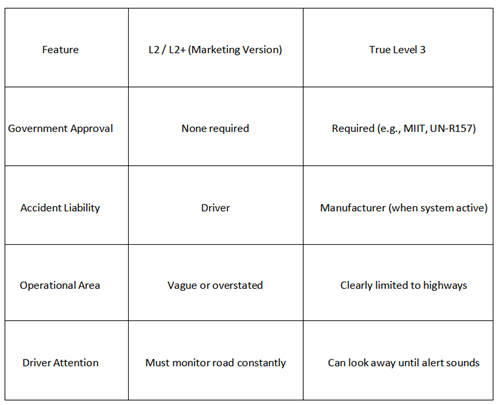
L2, L2+, L2++ — how do you know what's real?
The answer is simple. Trustworthy driving tech is built on clear liability, legal approval, and hardware safety. It is not built on a stack of "+" symbols. In 2026, almost every "smart driving" feature you can buy is still Level 2 driver assistance. True Level 3 is just beginning its commercial journey. Level 4 remains in the world of robotaxis and commercial pilots.
What should you do? Don't pay a premium just for the "L2+" label. In the eyes of the law, it is the same as basic L2. Look at results from independent testing agencies. They are more reliable than car commercials. And remember: until Level 3 or 4 is common, the most important safety feature in the car is your own judgment.
FAQ
Q1: What is the actual difference between L2, L2+, and L2++?
In the official SAE J3016 standard, these "+" categories do not exist (source: SAE International, J3016:2021). They are marketing terms. The core technology remains Level 2. The system helps with steering and speed, but the driver is legally responsible at all times.
Q2: How do I know if a car is truly Level 3?
Look for three things: (1) Government certification of Level 3 compliance. (2) A written statement from the manufacturer accepting liability. (3) Confirmation that you are allowed to look away from the road when the system is active. If any of these are missing, it is not a consumer Level 3 vehicle.
Q3: If I crash while using "Autopilot" or "Cruise," who is at fault?
If the system is Level 2, you are at fault. You are the driver in control of the vehicle, even if the system is helping with some tasks. Legal responsibility remains with the human driver at all times for L2 systems.
Q4: Can a software update turn my L2 car into an L3 car?
No. Level 3 requires extra hardware. This includes backup steering motors, backup braking systems, and backup power supplies. These are physical parts that cannot be downloaded. If a company promises a future software update will make the car "Level 3," be very cautious.
References
[1] SAE International (2021). *J3016: Taxonomy and Definitions for Terms Related to Driving Automation Systems for On-Road Motor Vehicles.
[2] UNECE (2020). UN Regulation No. 157 – Uniform provisions concerning the approval of vehicles with regard to Automated Lane Keeping Systems.
[3] UK Department for Transport (2025). Automated Vehicles Act 2024: Consultation on Protecting Marketing Terms.
[4] European Transport Safety Council (2025). ETSC supports UK proposals to restrict misleading marketing of assisted driving systems.
[5] Chu, Y., Tang, W., Chen, S., & Liu, P. (2026). Imperfect advanced driver assistance systems in the eyes of imperfect users. Transportation Research Part F: Traffic Psychology and Behaviour, 103447.
About the Author
Michael D. Reynolds is an automotive technology analyst based in Detroit, Michigan. With over 12 years of experience in vehicle electronics and advanced driver-assistance systems (ADAS), he holds a Master's degree in Mechatronic Engineering from the University of Michigan. He specializes in the intersection of autonomous vehicle policy, consumer safety, and human-machine interface design. His work has been cited in industry white papers and automotive trade publications.
Disclaimer
This article is based on public information available as of April 23, 2026. It is for informational purposes only and does not constitute buying advice or legal counsel. Autonomous driving technology and regulations are changing rapidly. Always verify product specifications and liability terms with the official manufacturer documentation. Driving safety is the top priority. No matter what level of assistance your vehicle has, stay alert and follow the rules of the road. The author and publisher are not liable for any direct or indirect consequences resulting from the use of this information.
Related Articles
Aggressive America, Cautious Europe, Steady China: Is the Global L3 Self-Driving Track Really Diverging?https://zhongtaiserver.zhongtongtec.com/storage/WebsiteAdmin/view/2026-04/autotriad.com/driving/aggressive-america-cautious-europe-steady-china-is-the-global-l3-selfdriving-track-really-diverging.html
Recommended for you: